Focus Keyword: PMT score check by CNIC
Secondary Keywords: PMT score check online, check PMT score by CNIC, BISP PMT score, 8171 PMT check, BISP eligibility check, NSER PMT score, CNIC eligibility check, BISP 8171 portal, PMT score Pakistan
SEO Slug: check-pmt-score-by-cnic-online
Introduction
The PMT score is an important part of Pakistan’s social protection and welfare system. Many people search online for terms such as “PMT score check by CNIC,” “BISP PMT score check,” “8171 PMT score,” and “check PMT score online” because they want to know whether their household qualifies for government assistance.
PMT stands for Proxy Means Test. It is a method used to estimate the socio-economic condition of a household by considering information collected through a household survey. In the context of BISP and other social protection programmes, this information helps determine whether a household falls within the eligibility criteria.
For users checking their status online, it is important to understand one key difference: the official 8171 web portal is primarily used to check household eligibility/status using a CNIC, while the exact internal PMT calculation or score may not always be displayed as a simple numerical value on the public portal. The official BISP material confirms that a CNIC can be checked through the 8171 portal for eligibility status.
This guide explains what the PMT score means, how to check your BISP status online using your CNIC, what to do if no record appears, and how to avoid fake websites and scams.
What Is a PMT Score?
PMT means Proxy Means Test. It is a socio-economic assessment method used to estimate the financial and living conditions of a household.
Instead of relying only on one piece of information, a household’s circumstances can be assessed using different types of information collected during a social registry or household survey. The resulting assessment helps programmes identify households that may qualify for targeted assistance.
The PMT score should therefore not be confused with a bank balance, salary figure, credit score, or simple income calculation. It is a welfare-programme assessment indicator.
For BISP-related eligibility, households are assessed against an approved eligibility cutoff. BISP’s official information explains that a household falling within the approved cutoff can be declared eligible for the relevant programme.
How Does the PMT System Work?
The basic purpose of a PMT assessment is to estimate a household’s socio-economic position using information collected during the relevant survey or registration process.
The information can relate to different aspects of household circumstances. The assessment is then used as part of determining eligibility under applicable programme criteria.
A simplified process looks like this:
- Household information is collected through the relevant survey or registry.
- The information is processed through the programme’s assessment system.
- A socio-economic assessment is generated.
- The household is compared against the relevant eligibility criteria.
- Eligible households may receive assistance according to the programme rules.
- Households that do not meet the applicable criteria may not qualify.
This means that simply entering a CNIC into a random website cannot legitimately generate a genuine PMT score. The information must come from the official system.
How to Check PMT Status by CNIC Online
For BISP-related eligibility, the safest option is to use the official 8171 web portal.
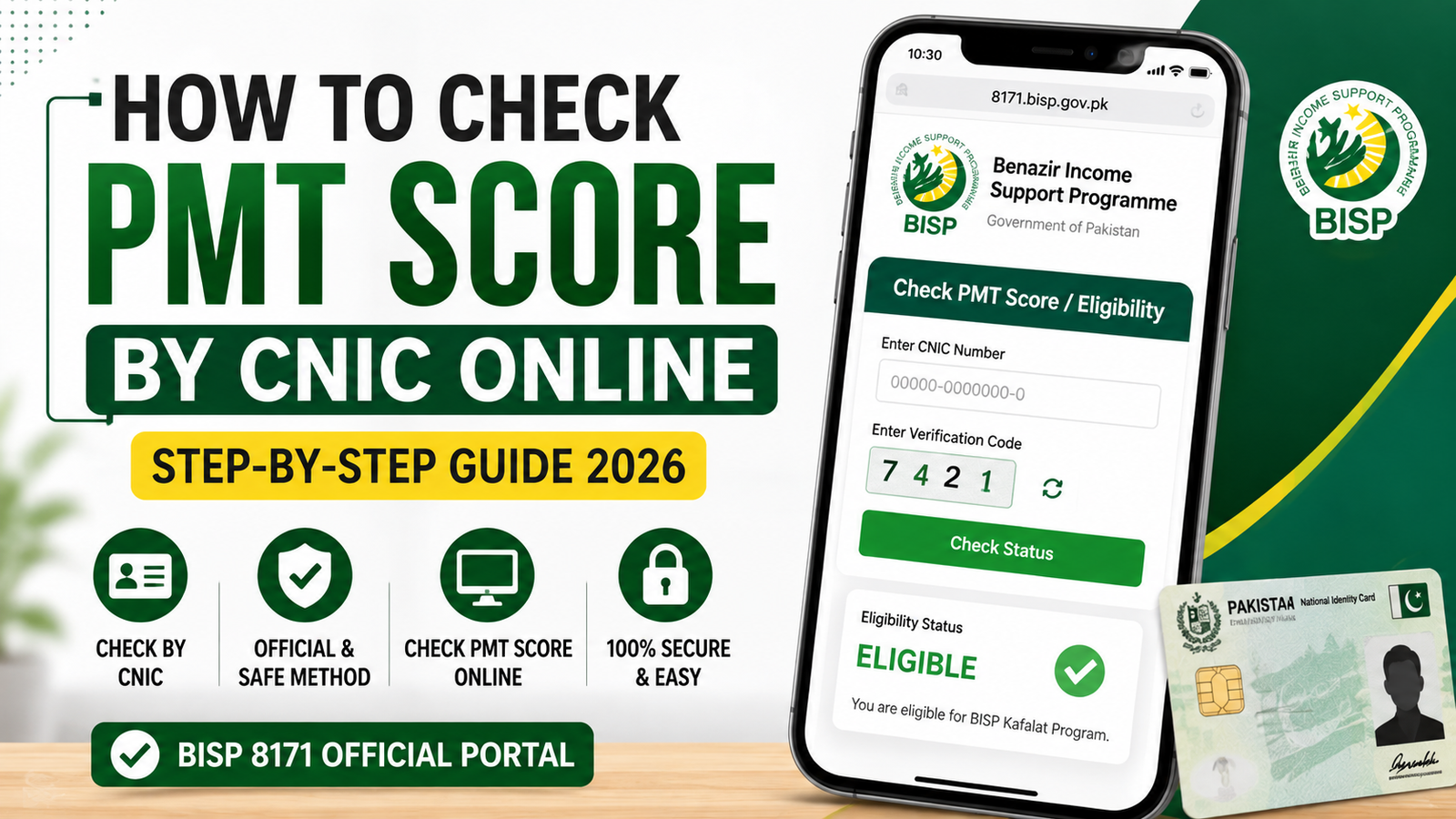
The official portal provides a CNIC field and a verification code for checking household eligibility information.
Step 1: Open the Official 8171 Portal
Use the official BISP 8171 web portal rather than a website found through an unknown social media post or message.
The official portal is provided by BISP and is specifically designed for checking household eligibility information.
Step 2: Enter Your CNIC
Enter your CNIC number in the required field.
Make sure the number is entered correctly. A typing mistake can result in an incorrect response or a message indicating that no record is available.
Step 3: Enter the Verification Code
The portal may display a verification image or code. Enter the requested code carefully.
This step helps prevent automated misuse of the service.
Step 4: Submit the Information
After entering the required information, submit the form.
The system can then provide the available eligibility/status information associated with the CNIC.
Step 5: Understand the Result
The result may indicate whether your household has a record or whether you need to take another step.
Remember that an online eligibility result should not automatically be interpreted as a publicly displayed numerical PMT score. The public 8171 service is designed around eligibility/status checking. If you need clarification about your household survey or assessment, the appropriate BISP office is the safer route.
Does the 8171 Portal Show the Exact PMT Score?
This is an important point for anyone searching for “PMT score check by CNIC online.”
The official 8171 portal provides a way to check household eligibility information using a CNIC. BISP’s published guidance also describes checking eligibility through the 8171 portal.
However, users should not assume that entering a CNIC will always display an exact numerical PMT score.
If your result provides eligibility information but does not show a numerical score, that does not necessarily mean there is a problem with your record. The public portal and the underlying assessment system serve different purposes.
For questions about your household survey, record, or eligibility assessment, use an official BISP Tehsil Office or other authorized BISP channel rather than relying on an unofficial website claiming to reveal your exact score.
What Does a BISP Eligibility Result Mean?
A BISP eligibility result is related to whether a household meets the criteria for a particular programme.
Eligibility can depend on the programme, household information, assessment results, and applicable government rules.
Therefore, an online status should be understood carefully.
Possible situations can include:
- Eligible household.
- Record available but requiring further action.
- No record found.
- Survey or registration information requiring attention.
- Household not currently meeting the applicable criteria.
- Information requiring verification through an official channel.
The exact message shown by the system can vary, so users should follow the instructions provided by the official portal.
What to Do If Your CNIC Shows No Record
If your CNIC does not produce the expected result, do not immediately assume that you are permanently ineligible.
BISP’s official guidance states that when there is no record on the 8171 portal, an adult household member may visit the nearest BISP registration desk established at a BISP Tehsil Office for a household survey.
Depending on your situation, you may need to:
- Recheck your CNIC number.
- Try the official 8171 portal again.
- Confirm that the portal is working properly.
- Visit the relevant BISP Tehsil Office if no record is available.
- Ask about the household survey process.
- Keep your original CNIC available for official verification.
- Provide accurate household information during the survey.
Do not pay an unofficial person to “activate” your PMT score or create a fake BISP record.
What Is the Relationship Between PMT and BISP?
PMT is closely associated with the process of identifying households that may qualify for targeted social protection programmes.
BISP uses household socio-economic information to determine eligibility under its programme rules. Its official material explains that a household falling within an approved cutoff can be declared eligible.
This means that PMT is not simply a separate online application where anyone can enter a CNIC and receive a score. It is part of a broader household assessment process.
Benefits of Checking Your BISP Status Online
Using the official online system can make it easier to understand your current status without immediately visiting an office.
Some benefits include:
- Quick access to available eligibility information.
- Convenient CNIC-based status checking.
- Less need for unnecessary office visits.
- Easier monitoring of household status.
- Ability to identify whether further action may be required.
- Access to official information without paying an intermediary.
- Better protection against unofficial agents.
Online checking is especially useful for people who want to verify their status before visiting a BISP office.
Important Documents for BISP-Related Verification
If you need to visit an official BISP office, keep the relevant documents available.
These may include:
- Original CNIC.
- Mobile number used for household communication.
- Relevant household information.
- Existing BISP or survey information, if available.
- Any official SMS or reference information you have received.
Always follow the instructions provided by BISP officials because document requirements can vary depending on the service you need.
BISP 8171 SMS and Scam Protection
Scams involving government assistance programmes can be dangerous because fraudsters may use people’s financial difficulties to obtain personal information or money.
BISP has repeatedly emphasized that 8171 is its official SMS number and has warned people not to trust messages from other numbers claiming to represent BISP.
BISP has also stated that there is no fee for the BISP survey and advised people to report illegal demands for money.
Keep these safety rules in mind:
- Do not pay anyone for a BISP survey.
- Do not share OTP codes with strangers.
- Do not give your CNIC photo to unknown individuals online.
- Do not trust unofficial WhatsApp messages claiming to be BISP.
- Do not click suspicious links promising instant payments.
- Do not install unknown applications for PMT checking.
- Do not provide banking information to an unofficial agent.
- Verify information through official BISP channels.
How to Protect Your CNIC Information
Your CNIC is an important identity document, so it should be handled carefully.
When checking your PMT or BISP status online:
- Use official websites only.
- Check the website address before entering your CNIC.
- Avoid random websites offering “100% PMT score details.”
- Do not upload CNIC images unnecessarily.
- Never share OTP codes.
- Avoid sending personal documents to unknown social media accounts.
- Use official government offices for identity verification.
- Keep screenshots of legitimate applications or complaints when necessary.
A website that claims to have access to a secret database of PMT scores should be treated with suspicion.
Alternatives for Checking BISP and PMT-Related Information
- 8171 Web Portal – The official online portal for checking household eligibility information using a CNIC.
- 8171 SMS Service – BISP identifies 8171 as its official number for programme-related messages.
- BISP Tehsil Office – Useful when there is no record online or when you need assistance with the household survey or eligibility information.
- BISP Registration Desk – Can assist eligible households with the relevant survey and registration process when no record is found through the online system.
- BISP Complaint Channels – Useful for reporting issues, payment deductions, fraud, or other programme-related problems. BISP has published its official helpline and complaint guidance.
Tips for Checking PMT Status Online Safely
For a smooth and secure experience, follow these practical tips:
- Use the official 8171 portal.
- Enter your own CNIC carefully.
- Keep your CNIC information private.
- Check the result before visiting an office.
- Follow official instructions if no record appears.
- Use only authorized BISP offices for further assistance.
- Never pay a fee for a BISP survey.
- Trust official BISP communication channels.
- Keep your registered mobile number active.
- Report suspicious messages or payment demands.
BISP has also advised beneficiaries to keep the mobile number provided during the survey in regular use and to report changes to the BISP office when necessary.
Why You Should Avoid Fake PMT Score Websites
The popularity of searches such as “PMT score check online” has created opportunities for misleading websites and social media pages.
A fake website may ask for your:
- CNIC number.
- Mobile number.
- OTP.
- Bank account information.
- ATM details.
- Personal photographs.
- CNIC front and back images.
There is no good reason to provide sensitive financial information to an unknown website simply because it claims to show your PMT score.
If a service asks for money or sensitive information in exchange for BISP eligibility information, stop and verify the service through official BISP channels.
Conclusion
Checking your PMT or BISP eligibility status by CNIC can be done safely through official channels. For online checking, the 8171 BISP portal provides a CNIC-based household eligibility/status check, while BISP’s official guidance explains what to do when no record is found.
One important point is that an online eligibility result should not automatically be treated as an exact numerical PMT score. If the portal does not display a specific score, use an official BISP Tehsil Office or registration desk for clarification rather than relying on third-party websites.
Most importantly, protect your CNIC, mobile number, OTP, and financial information. BISP has confirmed that 8171 is its official number and has warned users about fraudulent messages from other numbers. By using official channels and avoiding unofficial agents, you can check your status more safely and reduce the risk of fraud.
Disclaimer
This article is for educational and informational purposes only. BISP eligibility and PMT assessment are determined through official government systems and applicable programme rules. This guide does not guarantee eligibility or a specific PMT score. Always verify your information through official BISP channels, and never share sensitive personal or financial information with unauthorized individuals or websites.