Introduction
The BISP 8171 eligibility check by CNIC is one of the most searched government-service topics in Pakistan. People who have registered with the Benazir Income Support Programme (BISP) often want to know whether their household is eligible, whether their survey record is available, or whether they need to complete another step before receiving assistance.
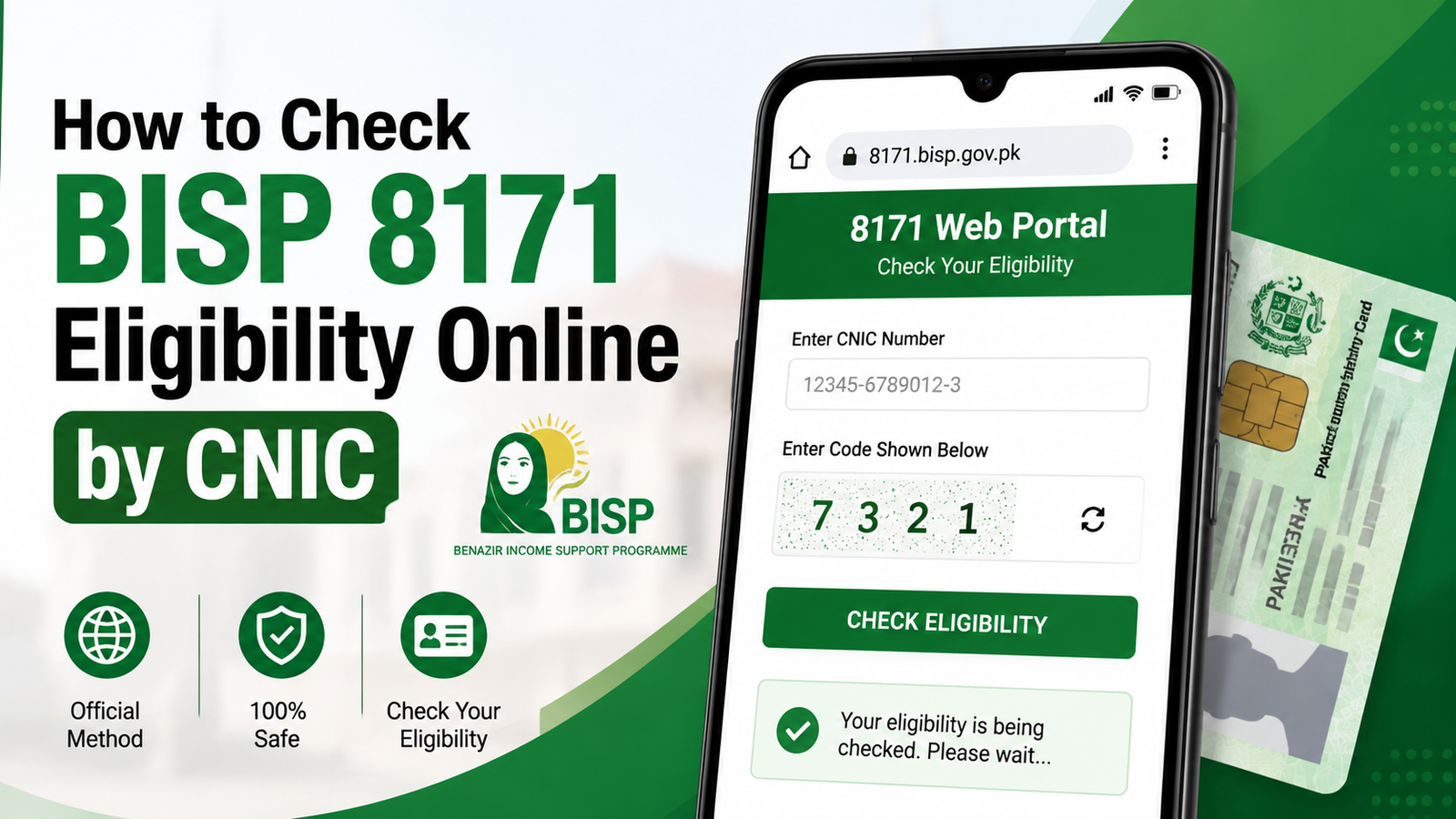
BISP provides an official 8171 web portal where users can enter their CNIC and verification code to check household eligibility information. The official portal currently provides a CNIC field and captcha-style verification before submitting a status request.
BISP’s own published guidance also confirms that a CNIC can be checked through the 8171 portal to determine eligibility status. If there is no record on the portal, an adult household member may visit the nearest BISP registration desk at a BISP Tehsil Office for a household survey.
This complete 2026 guide explains what BISP 8171 is, how to check eligibility online using your CNIC, what different results can mean, what to do if no record is found, how BISP registration works, and how to protect yourself from fake websites and fraudulent messages.
What Is BISP 8171?
BISP 8171 is the commonly used name for the BISP system through which eligible households can receive information and check their status. The Benazir Income Support Programme is a government social protection programme designed to provide financial assistance to eligible households under its various programmes.
BISP uses household and socio-economic information to determine eligibility for relevant assistance programmes. The official BISP information explains that households are assessed through the National Socio-Economic Registry (NSER) and the Proxy Means Test (PMT) system for the Benazir Kafaalat Programme.
The number 8171 is particularly important because BISP has repeatedly stated that it is the official number used for BISP messages. BISP has warned beneficiaries not to trust messages from other numbers claiming to represent the programme.
What Is BISP 8171 Eligibility?
BISP eligibility refers to whether a household or individual meets the requirements of a particular BISP programme according to the applicable assessment and verification process.
Eligibility is not determined simply because someone owns a CNIC or submits a request online. BISP uses information from its official registration and socio-economic assessment systems.
For example, BISP’s official Kafaalat information states that households are identified through the NSER survey and PMT assessment, with eligibility determined according to the applicable approved cutoff.
This is why the 8171 portal should be considered a status-checking service, rather than a website where users can manually select or change their eligibility.
How to Check BISP 8171 Eligibility Online by CNIC
Checking your BISP status online is relatively simple when you use the official portal.
Step 1: Open the Official 8171 Web Portal
First, open the official BISP 8171 web portal.
The official portal currently displays an option for entering a CNIC number along with a verification code.
Always check that you are using the official BISP domain before entering your personal information.
Step 2: Enter Your CNIC Number
Enter your CNIC number in the required field.
Make sure the number is accurate. A typing mistake can cause the system to return an incorrect or unexpected result.
You should only check your own CNIC or use information you are legally authorized to handle.
Step 3: Enter the Verification Code
The 8171 portal displays a verification code that you need to enter before submitting the request. This helps prevent automated or abusive requests to the system.
Enter the code exactly as shown.
Step 4: Submit the Form
After entering your CNIC and verification code, submit the request.
The system will process the information and display the available status associated with the household record.
Step 5: Read the Eligibility Result Carefully
The result may tell you whether your household has an available record and what action, if any, is required.
Do not assume that every result means an immediate payment. Eligibility and payment are separate parts of the programme process.
If you are declared eligible, follow the official instructions provided by BISP rather than relying on an unofficial person or website.
What Information Do You Need for the 8171 Check?
For the basic online eligibility check, the official 8171 portal requires your CNIC and the displayed verification code.
For other BISP services, additional information or documents may be required.
Depending on the situation, you may need:
- Original CNIC.
- Active mobile number.
- Household information.
- Children’s B-Forms where applicable.
- Relevant survey information.
- Other documents requested by an authorized BISP office.
BISP has advised applicants and beneficiaries to keep their identity card and active mobile number available when dealing with programme-related services.
What Does Your BISP 8171 Result Mean?
The exact result displayed by the system can depend on your household’s record and programme status.
A result may indicate that:
- Your household has an available record.
- You are eligible under the relevant programme.
- Your information requires further action.
- No record is currently available.
- Your household needs to complete or update the relevant survey.
- You may not currently meet the applicable eligibility criteria.
It is important to read the exact message displayed by the official system rather than relying on screenshots or explanations from social media.
What If 8171 Shows No Record?
A “no record” result does not necessarily mean that you can never qualify for BISP.
BISP’s official guidance states that if there is no record on the 8171 portal, an adult member of the household may visit the nearest Benazir Registration Desk established at a BISP Tehsil Office for the household survey.
If you receive a no-record result:
- Check your CNIC number again.
- Make sure you are using the official portal.
- Try the service again if there is a temporary technical issue.
- Visit an authorized BISP Tehsil Office when necessary.
- Ask about the household survey process.
- Provide accurate information during registration.
- Keep your original CNIC with you.
- Do not pay an unofficial agent to create or update your record.
BISP has stated that there is no fee for its survey or registration.
How BISP Registration and Survey Work
The BISP registration process is based on household information rather than simply entering a CNIC online.
BISP’s NSER documentation describes a registration process in which citizens can check their survey and eligibility status online or through SMS, while people without an existing record can visit a registration center. The household survey collects information about household members and other socio-economic circumstances.
During the relevant registration process, information may include:
- Household members.
- CNIC information.
- Children’s B-Forms.
- Education information.
- Household assets.
- Income-related information.
- Other socio-economic details.
Providing accurate information is important because the assessment is based on the household information recorded in the official system.
What Is the PMT Score in BISP?
The Proxy Means Test (PMT) is part of the socio-economic assessment used by BISP for identifying households under relevant programmes.
BISP describes the PMT as a scale used to assess household welfare, with eligibility determined according to the applicable cutoff approved by BISP.
This means your PMT score should not be confused with:
- A bank credit score.
- A salary rating.
- A personal income number.
- A CNIC rating.
- A mobile SIM score.
It is a socio-economic assessment indicator used within the social protection system.
BISP 8171 Eligibility and Payment Are Not the Same
One common mistake is assuming that an eligibility result automatically means that money is ready for collection.
Eligibility means that the household has met the applicable programme requirements. Payment involves additional programme procedures and official communication.
BISP’s published guidance says eligible beneficiaries receive an SMS from 8171 and should follow the official instructions before collecting payments.
BISP has also advised beneficiaries not to visit payment centers until they have received the appropriate official payment message.
How to Check BISP Information Safely
Because BISP deals with CNICs, mobile numbers, household information, and financial assistance, users should be especially careful about scams.
Follow these safety practices:
- Use the official 8171 BISP portal.
- Check the website domain before entering your CNIC.
- Never share your OTP with strangers.
- Do not provide banking information to unofficial agents.
- Never pay someone for a BISP survey.
- Do not install unknown BISP-related applications.
- Avoid suspicious links received through WhatsApp.
- Do not send your CNIC photo to random social media accounts.
- Trust official BISP communication channels.
- Keep records of legitimate complaints or applications.
Official BISP 8171 Number
BISP has repeatedly emphasized that 8171 is its official number for BISP-related messages.
The programme has warned beneficiaries against trusting messages from other numbers that claim to be official BISP communications.
This is particularly important because scammers may send messages claiming that a person has been approved for a payment and then request a fee, OTP, CNIC information, or banking details.
If a message looks suspicious, do not click links or provide personal information until you verify it through an official BISP channel.
Benefits of Checking BISP Eligibility Online
The online 8171 service provides several practical benefits for people who want to check their status.
- Quick CNIC-based eligibility checking.
- Convenient access from a smartphone or computer.
- Less need for unnecessary office visits.
- Ability to check whether a household record is available.
- Easier identification of situations requiring further action.
- No need to pay an unofficial agent for a basic status check.
- Better access to official information.
The online service is particularly useful as a first step before visiting a BISP office.
What to Do If Your Information Has Changed
Household information can change over time. Changes in family circumstances, marital status, mobile number, household members, or other information may require an update through the appropriate official process.
BISP has advised beneficiaries to keep the mobile number provided during the survey in regular use and report changes through the relevant BISP office when necessary.
If your information has changed significantly, do not attempt to modify an official record through a third-party website. Contact BISP through its authorized channels.
BISP Re-Survey and Recertification
Existing beneficiaries should also pay attention to re-survey requirements.
BISP has stated that families receiving financial assistance may need to undergo re-survey or recertification after the applicable period to determine continued eligibility.
If you receive an official instruction to update your survey, follow the instructions provided by BISP and use an authorized Tehsil Office or registration center.
Do not pay anyone who claims they can guarantee continued eligibility.
Alternatives for Checking BISP 8171 Information
- BISP 8171 Web Portal – The official online service for checking household eligibility information using a CNIC.
- 8171 SMS Service – BISP identifies 8171 as its official number for programme-related messages.
- BISP Tehsil Office – Useful for registration, survey-related issues, complaints, and cases where no record is available online.
- Benazir Registration Desk – Provides household survey and registration assistance for people whose records are not available or require updating.
- Official BISP Complaint Channels – Useful for reporting payment deductions, fraud, registration problems, or other programme-related complaints.
Common Mistakes to Avoid
When checking BISP 8171 eligibility online, avoid these mistakes:
- Entering your CNIC on an unofficial website.
- Believing every Facebook or WhatsApp post about BISP.
- Paying an agent for a free survey.
- Sharing your OTP.
- Giving your ATM PIN to anyone.
- Sending your CNIC image to unknown people.
- Installing unofficial BISP applications.
- Visiting a payment center without official payment instructions.
- Assuming eligibility guarantees an immediate payment.
- Repeatedly submitting information when the official system has not requested it.
These simple precautions can protect both your personal information and your money.
Conclusion
Checking BISP 8171 eligibility online by CNIC is a straightforward process when you use the official government portal. The 8171 web portal allows users to enter their CNIC and verification code to check available household eligibility information.
If your record is not found, BISP’s official guidance recommends visiting the nearest Benazir Registration Desk at a BISP Tehsil Office for the appropriate household survey process.
The most important thing is to use official channels. BISP has confirmed that 8171 is its official SMS number and has warned people not to trust messages from other numbers. It has also stated that there is no fee for the BISP survey or registration.
By checking your status through the official 8171 portal, keeping your information accurate, protecting your CNIC and OTP, and avoiding unofficial agents, you can check your BISP eligibility more safely in 2026.
Disclaimer
This article is provided for educational and informational purposes only. BISP eligibility is determined by the official government system and applicable programme rules. This guide does not guarantee eligibility or payment. Always verify your status through official BISP channels and never share your CNIC, OTP, banking information, or other sensitive details with unauthorized individuals or websites.