Introduction
Knowing whether you qualify for financial assistance, government benefits, discounts, loans, or other financial programs can save time and help you make better financial decisions. In the United States, however, there is no single website that determines eligibility for every type of financial program.
Different programs use different requirements. Some may consider household income, family size, age, disability status, employment, residency, assets, credit history, or participation in another qualifying program. Government programs can also have federal, state, or local eligibility rules.
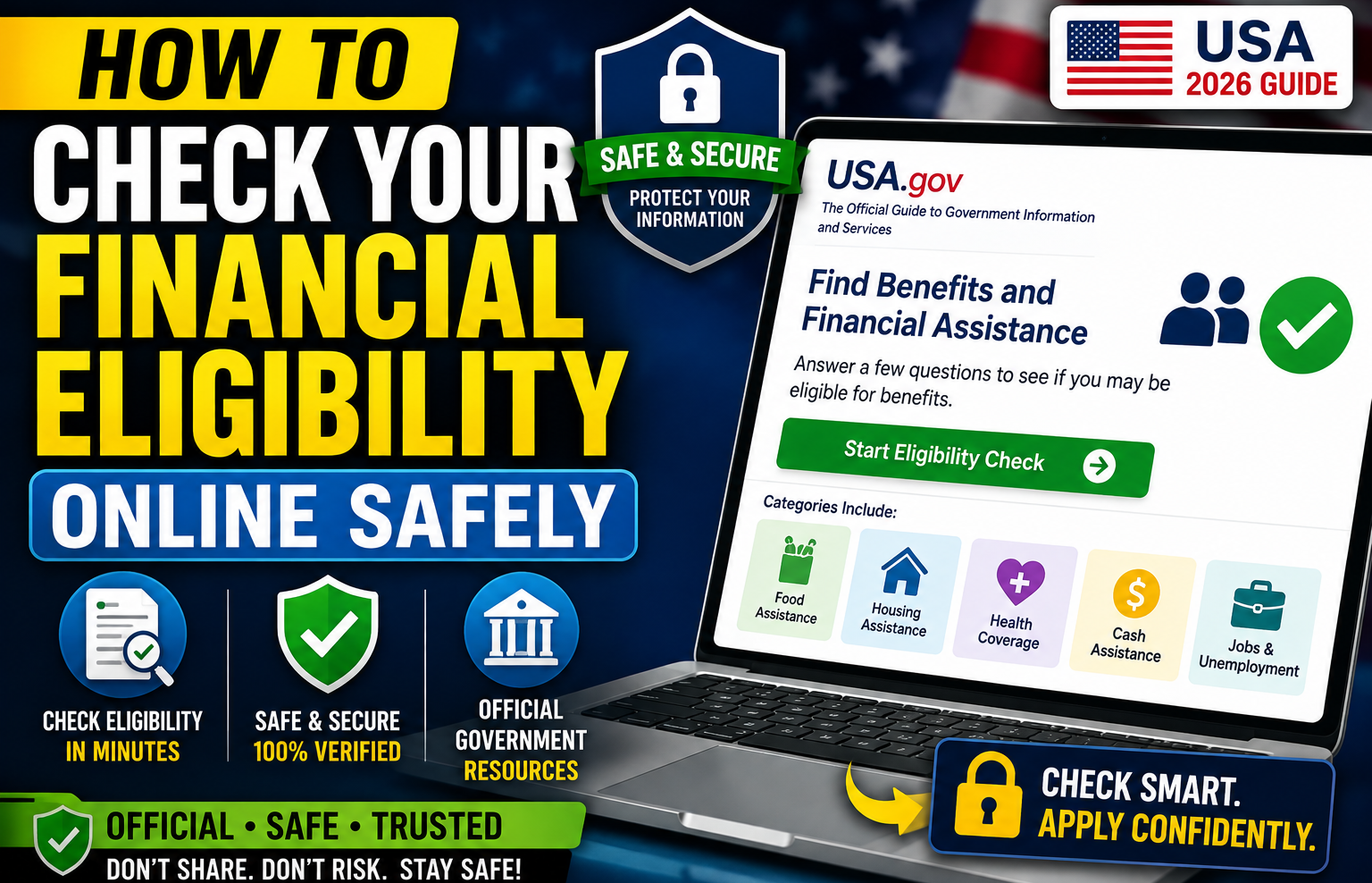
The safest approach is to start with trusted official resources rather than entering sensitive information into an unfamiliar “eligibility checker.” USA.gov provides a centralized way to find government benefits and financial assistance, while individual agencies such as the Social Security Administration provide their own eligibility tools. (USAGov)
This complete 2026 guide explains how to check your financial eligibility online safely in the USA, what information you may need, how income requirements work, how government benefit eligibility differs from loan eligibility, how to identify legitimate websites, and how to protect your personal and financial information.
What Is Financial Eligibility?
Financial eligibility means meeting the requirements established by a particular program, organization, lender, or government agency.
The exact requirements depend on what you are applying for.
For example, eligibility for a government assistance program may depend on:
- Household income.
- Household size.
- State of residence.
- Age.
- Employment status.
- Disability or other qualifying circumstances.
- Existing participation in another government program.
- Assets or other financial information.
- Citizenship or eligible immigration requirements where applicable.
A private lender may instead consider factors such as credit history, income, debt, employment, and other underwriting information.
Therefore, financial eligibility is not the same thing as having a high credit score or a certain amount of money in your bank account.
Why Check Financial Eligibility Online?
Online eligibility tools can make it easier to determine which programs may be relevant before starting a full application.
The official USA.gov Benefit Finder asks basic questions and provides a customized list of government benefits a person or family may potentially qualify for. The tool covers areas including food, housing and utilities, health, education, employment, disability, retirement, and financial assistance. (USAGov)
Checking eligibility online can help you:
- Find programs that may match your circumstances.
- Understand basic requirements.
- Save time before applying.
- Prepare necessary documents.
- Compare available assistance programs.
- Identify the correct government agency.
- Avoid unnecessary applications.
- Recognize when additional verification is required.
An online eligibility result is usually a starting point rather than a guarantee that you will receive money or benefits.
How to Check Your Financial Eligibility Online
Step 1: Identify What Type of Financial Help You Need
Before entering personal information anywhere, determine what you are actually trying to qualify for.
Possible categories include:
- Government financial assistance.
- Food assistance.
- Housing assistance.
- Utility assistance.
- Health-related assistance.
- Social Security benefits.
- Unemployment benefits.
- Student financial aid.
- Government loans.
- Tax-related benefits.
- Credit products.
- Local or state assistance.
This first step is important because every category can have completely different eligibility rules.
Step 2: Start With an Official USA Resource
For government benefits, start with USA.gov, the official guide to U.S. government information and services.
USA.gov provides access to benefit information and financial-assistance resources and can help users identify programs they may qualify for. (USAGov)
You can also use the official website of the federal agency responsible for the specific program.
Step 3: Use the Official Eligibility Tool
Some government agencies provide online questionnaires or eligibility tools.
For example, the Social Security Administration provides a tool where users can answer questions to see which Social Security benefits they may potentially qualify for. (Social Security Administration)
Similarly, certain government programs use online systems to verify income, identity, address, or participation in qualifying programs.
Step 4: Provide Accurate Information
Eligibility tools are only useful when the information entered is accurate.
Depending on the program, you may need information such as:
- Household size.
- Monthly or annual income.
- Employment information.
- State of residence.
- Housing expenses.
- Current benefits.
- Age.
- Family information.
- Other financial information.
Never intentionally enter false information to make yourself appear eligible.
Step 5: Review the Result Carefully
An online result may say that you may qualify, that additional information is required, or that you do not currently appear eligible.
A preliminary eligibility result does not always mean final approval.
The agency may still need to verify documents, income, identity, residency, or other information before making a final decision.
What Information Is Used to Determine Financial Eligibility?
There is no universal financial eligibility formula.
Each program establishes its own rules.
However, income is one of the most common factors used by needs-based programs.
Other common factors include:
- Household size.
- Annual income.
- Monthly income.
- Employment status.
- Age.
- Residency.
- Family circumstances.
- Assets.
- Existing government benefits.
- Disability status where relevant.
- Program-specific requirements.
For example, the U.S. Department of Health and Human Services publishes annual Federal Poverty Guidelines that are used in determining eligibility for certain programs. The 2026 Federal Poverty Guidelines were issued in January 2026. (HHS.gov)
This is why an income amount that qualifies a person for one program may not automatically qualify them for another.
Understanding Income Eligibility
Income eligibility can be confusing because programs do not necessarily use the same definition of income.
A program might ask about:
- Gross income.
- Net income.
- Adjusted income.
- Household income.
- Monthly income.
- Annual income.
The program’s official rules determine which income definition applies.
For example, HHS’s 2026 poverty guidelines list a guideline of $15,960 for a one-person household in the 48 contiguous states and District of Columbia, with higher amounts for larger households. Alaska and Hawaii have separate figures. (ASPE)
However, you should not assume that being below or above the Federal Poverty Guidelines automatically determines eligibility for every program.
Different programs can apply different percentages, deductions, definitions, and additional requirements.
Government Benefits vs. Financial Products
One of the most important distinctions is between government benefits and private financial products.
Government benefit programs may provide assistance with:
- Food.
- Housing.
- Utilities.
- Health care.
- Unemployment.
- Retirement.
- Disability.
- Family support.
USA.gov lists these types of programs and directs users toward federal and state resources. (USAGov)
Private financial products are different.
For example, a bank considering you for a personal loan may evaluate:
- Credit history.
- Income.
- Existing debt.
- Employment.
- Debt-to-income ratio.
- Loan amount.
- Repayment ability.
A government benefit eligibility result therefore should not be interpreted as approval for a private loan or credit card.
How Credit Can Affect Financial Eligibility
Credit information can be important when you are checking eligibility for certain financial products.
A lender may review your credit history and credit score when deciding whether to approve an application and what terms to offer.
However, credit eligibility and government-benefit eligibility are two different concepts.
Someone can have a strong credit profile but not qualify for a needs-based benefit. Conversely, someone with limited credit history may still qualify for certain government assistance programs.
This distinction helps prevent confusion when searching online for “financial eligibility.”
How to Check Eligibility for Government Assistance
If your goal is to find financial help from the government, USA.gov is one of the best places to start.
Its Benefit Finder allows users to answer basic questions and search for potential programs. Categories include children and families, food, health, housing and utilities, jobs and unemployment, retirement, disability, and welfare or cash assistance. (USAGov)
For financial hardship, USA.gov also provides information about programs related to food, housing, unemployment, welfare, rent assistance, and utility bills. (USAGov)
This can be more reliable than searching social media for random “government assistance” links.
State-Level Financial Eligibility
Not every financial assistance program is administered at the federal level.
Some programs are operated by individual states or local governments.
For example, TANF is federally funded but state-run, and each state or tribal government has its own requirements and program structure. (USAGov)
This means two households with similar financial circumstances could potentially receive different results depending on where they live.
When an online federal resource directs you to a state agency, use the official state website rather than a third-party application site.
Online Eligibility Verification
Some programs use automated systems to verify information.
For example, the Lifeline National Eligibility Verifier checks information supplied by consumers against available databases. USAC explains that the system can verify identity and address and may also verify participation in qualifying programs such as SNAP, Medicaid, SSI, or certain housing and veterans programs. (USAC)
If information cannot be automatically verified, some systems allow applicants to submit additional documentation for manual review.
This is why you should keep official documents available when applying for financial assistance.
Documents You May Need
The exact documents depend on the program.
Potentially requested information may include:
- Government-issued identification.
- Social Security number.
- Proof of income.
- Pay stubs.
- Tax documents.
- Proof of address.
- Household information.
- Benefit documentation.
- Employment information.
- Bank or asset information where required.
- Immigration or residency documentation where applicable.
Do not upload documents simply because a random website asks for them.
First confirm that the website belongs to the correct government agency or legitimate organization.
How to Identify a Safe Eligibility Website
Online financial scams often use words such as “free money,” “government grant,” “instant approval,” or “guaranteed benefits.”
USA.gov specifically warns consumers about scams promising “free money” from the government and recommends using official government resources to find legitimate financial assistance programs. (USAGov)
Before entering personal information:
- Check the website domain.
- Look for an official government website.
- Avoid suspicious shortened links.
- Don’t trust unsolicited text messages.
- Don’t download unknown applications.
- Don’t send money to “unlock” an eligibility result.
- Don’t provide your banking PIN.
- Don’t share one-time verification codes.
- Don’t provide your Social Security number to an unverified website.
- Confirm the program through an official agency.
Benefits of Checking Financial Eligibility Online
Online eligibility checking offers several advantages when used correctly.
- Convenient access from a phone or computer.
- Faster identification of relevant programs.
- Less unnecessary paperwork.
- Better preparation before applying.
- Access to official eligibility information.
- Easier comparison of different assistance categories.
- Ability to review requirements before submitting documents.
- Reduced dependence on unofficial agents.
- Easier access to state and federal resources.
The biggest advantage is that you can research your options before committing time to a full application.
Common Mistakes to Avoid
Financial eligibility searches can become risky when users rely on unofficial websites or misunderstand preliminary results.
Avoid these common mistakes:
- Assuming one eligibility calculator works for every program.
- Entering false income information.
- Applying through an unknown website.
- Paying someone for a free government eligibility check.
- Sharing your Social Security number unnecessarily.
- Confusing eligibility with final approval.
- Assuming eligibility guarantees a payment.
- Ignoring state-specific requirements.
- Using outdated income limits.
- Trusting social media posts without verification.
- Downloading unofficial government applications.
Remember that eligibility rules can change, so always check the current requirements on the official program website.
Alternatives for Checking Financial Eligibility
- USA.gov Benefit Finder – Helps users identify government benefits and financial assistance programs they may potentially qualify for. (USAGov)
- Social Security Administration – Provides an online eligibility questionnaire for Social Security benefits. (Social Security Administration)
- State Benefit Portals – State agencies provide eligibility and application information for programs administered at the state level.
- USAC National Verifier – Used to verify eligibility for the Lifeline program through government and other authorized data sources. (USAC)
- USA.gov Financial Assistance Resources – Provides information about food, housing, utilities, unemployment, welfare, and other forms of assistance. (USAGov)
How to Protect Your Financial Information
Financial eligibility applications can involve extremely sensitive information.
Protect yourself by using a few basic security practices.
- Use official websites whenever possible.
- Check the domain before submitting information.
- Use strong passwords for online accounts.
- Enable multi-factor authentication when available.
- Avoid using public computers for sensitive applications.
- Keep copies of submitted documents.
- Don’t share account passwords.
- Never share banking PINs.
- Be cautious with unsolicited calls and text messages.
- Monitor your financial accounts for unusual activity.
If you believe a financial assistance website is fraudulent, stop providing information and report the suspected scam through the appropriate official channel.
What If You Are Not Eligible?
A result showing that you do not appear eligible for one program does not necessarily mean that you cannot receive any financial assistance.
Different programs have different requirements.
For example, USA.gov lists separate categories for food, housing, health, utilities, unemployment, retirement, disability, and welfare assistance. (USAGov)
If you don’t qualify for one program:
- Check other benefit categories.
- Review your state’s assistance programs.
- Check whether household circumstances have changed.
- Review updated eligibility requirements.
- Contact the responsible agency.
- Look for programs specifically designed for your situation.
Never alter or misrepresent financial information simply to meet an eligibility requirement.
Conclusion
Learning how to check your financial eligibility online safely starts with understanding that there is no universal eligibility test for every financial program in the United States. Government benefits, financial assistance, credit products, loans, and other programs can all have different requirements.
For government assistance, USA.gov provides a useful starting point through its Benefit Finder and financial-assistance resources. (USAGov) Individual agencies, such as the Social Security Administration, also provide specialized eligibility tools. (Social Security Administration)
Income and household size can be important factors for many needs-based programs, while other programs may consider additional requirements. The 2026 Federal Poverty Guidelines are also used as a reference for determining eligibility for certain programs, but they do not automatically determine eligibility for every form of assistance. (ASPE)
The most important rule is to use official websites and protect your personal information. Avoid websites promising guaranteed government money, instant approval, or benefits in exchange for an upfront fee. USA.gov warns that “free money” offers are frequently scams and recommends using official resources to locate legitimate assistance. (USAGov)
By checking the correct program, providing accurate information, reviewing current requirements, and using trusted online resources, you can research your financial eligibility more safely and make better-informed decisions.
Disclaimer
This article is for educational and informational purposes only. It does not guarantee eligibility, approval, financial assistance, a loan, government benefits, or any specific payment. Eligibility requirements vary by program, agency, state, household circumstances, and applicable rules. Always verify current requirements through the official government agency or authorized provider before submitting an application or sensitive personal information. This article does not promote fraud, false information, identity misuse, or any unlawful activity.