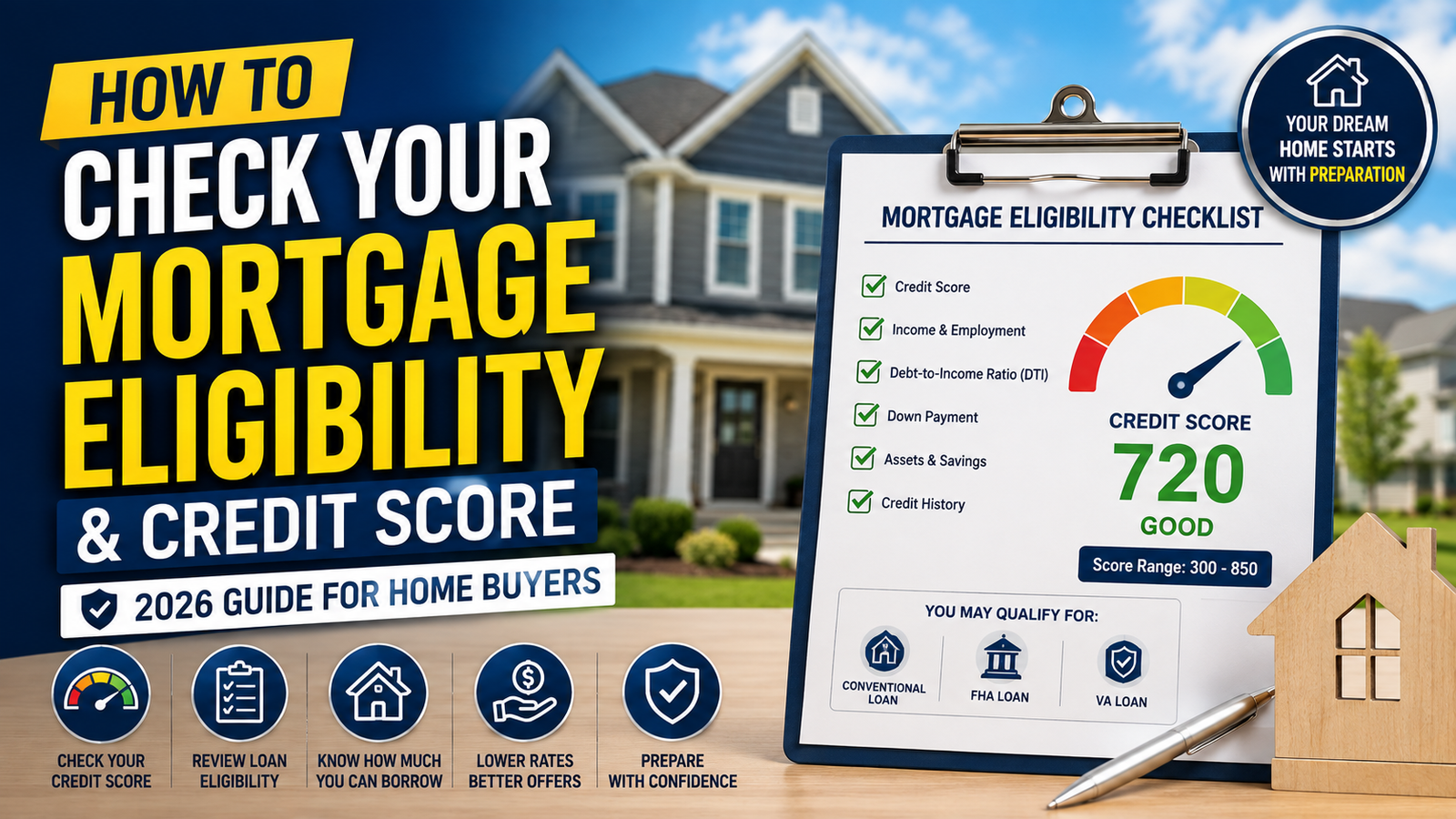
Buying a home starts long before you submit a mortgage application. One of the smartest financial moves you can make is checking your mortgage eligibility and understanding your credit score before applying. Doing this helps you estimate your borrowing power, avoid unnecessary hard inquiries, and improve your chances of qualifying for better interest rates.
This 2026 guide explains how mortgage eligibility works in the USA, what lenders look for, and the safest way to prepare your finances before applying.
What Is Mortgage Eligibility?
Mortgage eligibility is a lender’s assessment of whether you qualify for a home loan. Instead of looking at one factor, lenders evaluate your overall financial profile to estimate your ability to repay the loan.
The most common factors include:
- Credit score
- Household income
- Employment stability
- Debt-to-income (DTI) ratio
- Down payment
- Savings and cash reserves
- Credit history
- Loan amount requested
Every lender has its own approval criteria, so qualifying with one lender does not guarantee approval with another.
Why Your Credit Score Matters
Your credit score is one of the strongest indicators lenders use when pricing a mortgage. While there is no universal minimum score, stronger credit often leads to lower interest rates and better loan terms.
Generally:
- 740+ — Excellent borrowing potential
- 700–739 — Good mortgage opportunities
- 660–699 — Average qualification range
- 620–659 — May qualify with limited options
- Below 620 — Approval becomes more difficult for many conventional loans
Your score is important, but it is never the only factor.
How to Check Your Mortgage Eligibility
1. Review Your Credit Reports
Before applying, review your credit reports from the three major credit bureaus. Look for:
- Incorrect late payments
- Unknown accounts
- High balances
- Identity theft signs
- Duplicate accounts
Fixing errors before applying can strengthen your application.
2. Check Your Credit Score
Use a trusted credit score service or your bank’s free credit monitoring feature. Remember that mortgage lenders may use a different mortgage-specific scoring model than the consumer score you normally see.
3. Calculate Your Debt-to-Income Ratio
Your DTI shows how much of your monthly income already goes toward debt payments.
Formula:
Monthly Debt ÷ Gross Monthly Income × 100
Example:
- Monthly debt: $1,800
- Monthly income: $6,000
DTI = 30%
Lower DTI generally improves mortgage eligibility.
4. Estimate Your Down Payment
A larger down payment can reduce borrowing costs and improve approval chances.
Many buyers save between 3% and 20%, depending on the loan program and their financial situation.
5. Use Mortgage Prequalification
Many lenders offer online prequalification tools that provide an estimate of:
- Possible loan amount
- Estimated monthly payment
- Interest rate range
- Loan term options
Prequalification is helpful, but it is not a final approval.
Documents You’ll Usually Need
Prepare these before applying:
- Government-issued ID
- Social Security Number
- Recent pay stubs
- W-2 or tax returns
- Bank statements
- Employment information
- Proof of assets
- Down payment documentation
Having documents ready speeds up the application process.
What Can Improve Your Mortgage Eligibility?
Small financial improvements can make a big difference.
- Pay bills on time
- Reduce credit card balances
- Avoid opening unnecessary accounts
- Keep employment stable
- Increase your down payment
- Correct credit report errors
- Build emergency savings
- Avoid large purchases before closing
Common Mortgage Eligibility Mistakes
Avoid these mistakes before applying:
- Applying with multiple lenders without comparing first
- Ignoring your credit reports
- Underestimating monthly housing costs
- Making large purchases before approval
- Closing old credit accounts unnecessarily
- Using unofficial mortgage calculators
- Assuming prequalification guarantees approval
Alternatives for Checking Mortgage Readiness
- Bank Mortgage Prequalification – Estimate borrowing power before applying.
- Credit Union Home Loan Tools – Compare mortgage options and rates.
- FICO Mortgage Score Resources – Understand mortgage-specific scoring models.
- Housing Affordability Calculators – Estimate monthly payments and budgets.
- Official Credit Report Services – Review the information lenders may see.
Benefits of Checking Eligibility First
Checking your mortgage readiness before applying helps you:
- Estimate your budget
- Compare lenders confidently
- Reduce application stress
- Improve approval chances
- Find better interest rates
- Prepare financial documents early
- Avoid unnecessary hard inquiries
- Make smarter home-buying decisions
Conclusion
Checking your mortgage eligibility and credit score before applying is one of the best ways to prepare for homeownership. By reviewing your credit reports, calculating your DTI, estimating your down payment, and using prequalification tools, you’ll have a much clearer picture of what you can realistically afford.
The stronger your financial profile, the more options you’ll likely have when comparing mortgage lenders and interest rates.
Disclaimer
This article is for educational purposes only and does not guarantee mortgage approval or a specific interest rate. Mortgage eligibility depends on lender requirements, credit history, income, debt, and other financial factors.