Introduction
Your credit score is one of the most important numbers in your personal financial life in the United States. Banks, credit card companies, auto lenders, mortgage providers, and other businesses may use credit information when evaluating applications and determining the terms they offer. Because your credit profile can change over time, regularly checking your credit score and credit reports is a useful financial habit.
Fortunately, checking your credit information online has become easier than ever. Consumers can access free credit reports through the official AnnualCreditReport.com service, while many financial institutions and credit-monitoring services provide access to credit scores at no cost. The Consumer Financial Protection Bureau (CFPB) explains that consumers have more than one credit score because different scoring models, credit reporting companies, and lenders may use different information or calculations.
This complete 2026 guide explains how to check your credit score online in the USA, the difference between a credit score and credit report, where to find free options, how FICO and VantageScore differ, what affects your score, and how to protect yourself from misleading credit-score websites.
What Is a Credit Score?
A credit score is a numerical representation of information in your credit history. It is designed to help lenders estimate how likely you are to repay borrowed money according to the terms of a credit agreement.
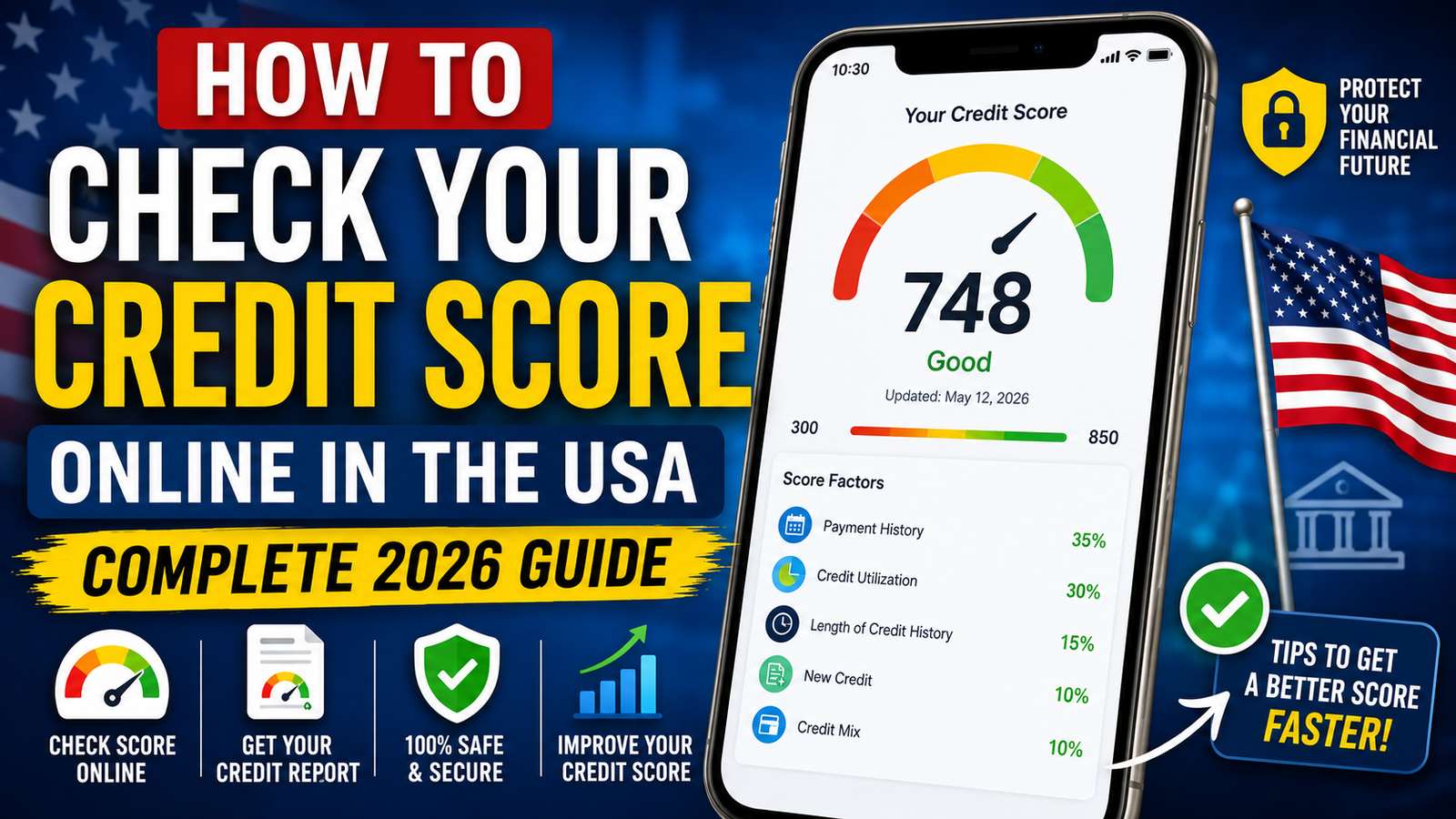
Credit scores are generally based on information contained in your credit reports, including factors such as payment history, credit utilization, length of credit history, types of accounts, and recent credit activity.
Most commonly encountered consumer credit scores are presented on a scale from 300 to 850, although the exact scoring range can depend on the model being used. VantageScore, for example, uses a 300–850 range for its current consumer models.
A higher score generally indicates a stronger credit profile, but there is no single score that every lender must use.
What Is a Credit Report?
A credit report is different from a credit score.
Your credit report contains information about your credit history, while a credit score is calculated using information from a credit report or other credit data.
A credit report can contain information such as:
- Credit card accounts.
- Auto loans.
- Mortgages.
- Student loans.
- Payment history.
- Account balances.
- Credit limits.
- Collections information.
- Credit inquiries.
- Account opening and closing dates.
The CFPB recommends reviewing your credit reports regularly because inaccurate information can negatively affect your credit history and potentially your score.
How to Check Your Credit Score Online
There are several legitimate ways to check your credit score online in the USA.
Check Through Your Credit Card Company
Many banks and credit card issuers provide customers with access to a credit score as part of their online account or mobile banking application.
Log in to your bank or credit card account and look for sections such as:
- Credit Score.
- Credit Monitoring.
- Credit Health.
- Financial Wellness.
- FICO Score.
- VantageScore.
The exact score model and credit bureau used can vary between financial institutions.
Check Through Experian
Experian provides a free online credit score option that includes a FICO Score 8 based on Experian data. Experian states that no credit card is required for its free score offering, although lenders may use a different FICO score or another scoring model.
This can be useful if you want to monitor a FICO score rather than only a VantageScore.
Check Through TransUnion
TransUnion currently offers a free service that provides access to a TransUnion credit report and VantageScore 3.0. Its current offering states that the free service does not require a credit card and that checking your own score does not affect your credit score.
Check Through FICO
FICO is one of the best-known credit-scoring brands in the United States. Its current free plan includes a one-bureau FICO Score 8 with monthly updates, although other FICO scores used for products such as mortgages or auto loans may not be included in the free plan.
This is particularly useful if you specifically want to understand your FICO score rather than a VantageScore.
How to Get Your Free Credit Reports
If you want to understand your credit properly, don’t check only your score. You should also review the underlying credit reports.
The official source for free credit reports from the three nationwide consumer reporting companies is AnnualCreditReport.com. The three major companies are:
- Equifax.
- Experian.
- TransUnion.
The CFPB confirms that consumers can obtain free credit reports through AnnualCreditReport.com. The CFPB also notes that online access can be available more frequently than the traditional annual schedule.
For 2026, the CFPB also notes that Equifax offers up to six additional free credit reports every 12 months through December 31, 2026.
Step-by-Step Credit Report Check
Checking your credit reports is straightforward.
Step 1: Use the Official Website
Go directly to AnnualCreditReport.com rather than clicking an unfamiliar advertisement or social media link.
Step 2: Select Your Reports
You can request reports from Equifax, Experian, and TransUnion.
Step 3: Verify Your Identity
You may need to answer identity-verification questions before accessing your reports.
Step 4: Review Every Account
Look carefully through your reports for accounts, balances, payment information, and inquiries.
Step 5: Look for Errors
Pay attention to information that does not belong to you or appears incorrect.
Step 6: Dispute Incorrect Information
If you find inaccurate information, follow the dispute instructions provided by the relevant credit reporting company and contact the company that supplied the information when appropriate. The CFPB recommends disputing inaccurate information rather than paying a credit-repair company to do something you can generally do yourself.
Credit Score vs. Credit Report
Understanding the difference between these two terms is important.
Credit Report: A detailed record of your credit-related information.
Credit Score: A number calculated from information used by a particular scoring model.
You can have multiple credit scores at the same time. For example, one service may show a FICO Score while another displays VantageScore. Even scores from the same general family can differ depending on which credit bureau’s data is used and when the score was calculated.
The CFPB specifically explains that consumers have multiple credit scores and that lenders may use different scores for different types of loans.
FICO Score vs. VantageScore
Two major names you may encounter when checking your credit are FICO and VantageScore.
FICO Score
FICO scores are widely used by lenders. Different FICO models exist for different lending purposes, so the score you see through a free consumer service may not be exactly the score used for a particular mortgage, auto loan, or credit-card application.
For example, Experian’s current free score offering provides FICO Score 8 based on Experian data.
VantageScore
VantageScore is another credit-scoring system developed by the three major credit reporting companies. Experian’s 2026 explanation notes that VantageScore’s latest models use a 300–850 range.
TransUnion currently provides a free VantageScore 3.0 through its free credit service.
Neither score should automatically be considered your one universal “true” credit score. The model and data source matter.
Does Checking Your Own Credit Score Hurt Your Credit?
Generally, checking your own credit information does not lower your credit score.
The CFPB explains that requesting your own credit report does not hurt your score because it is not an application for new credit.
TransUnion likewise states that checking your own score is a soft inquiry and does not affect your credit score.
This makes regular credit monitoring a useful habit, especially when you are preparing for a major financial decision.
What Affects Your Credit Score?
Different scoring models weigh information differently, but several major factors commonly influence credit scores.
Payment History
Paying credit obligations on time is one of the most important credit habits.
Late payments can negatively affect your credit profile, particularly when they are reported to the credit bureaus.
Credit Utilization
Credit utilization refers to how much of your available revolving credit you are using.
For example, if you have a combined credit limit of $10,000 and balances totaling $2,000, your utilization is 20%.
Keeping revolving balances relatively low can help your credit profile.
Length of Credit History
A longer credit history can provide more information about your borrowing behavior.
Closing older accounts without considering the consequences can sometimes affect your credit profile, so avoid making major credit decisions without understanding how they may affect you.
Credit Mix
Having different types of credit accounts can be considered by some scoring models.
However, you should never take out a loan simply to create a particular credit mix.
New Credit
Opening multiple new accounts or applying for several credit products within a short period can affect your credit profile.
The CFPB recommends applying only for credit you actually need.
Benefits of Checking Your Credit Score Regularly
Regular credit monitoring can help you make better financial decisions.
- Track changes in your credit profile.
- Identify potential errors.
- Detect unfamiliar accounts.
- Monitor your progress after paying down debt.
- Prepare for a future loan application.
- Understand factors affecting your score.
- Detect signs of potential identity theft.
- Maintain better financial awareness.
- Monitor changes after opening or closing accounts.
- Make more informed borrowing decisions.
The CFPB specifically recommends checking credit reports because errors can hurt credit history and scores.
What to Look for on Your Credit Report
Don’t just look at the score. Review the details behind it.
Check for:
- Accounts you don’t recognize.
- Incorrect balances.
- Incorrect payment history.
- Duplicate accounts.
- Incorrect personal information.
- Accounts marked open after being closed.
- Unfamiliar hard inquiries.
- Incorrect collection accounts.
- Old information that should no longer appear.
- Suspicious activity that could indicate identity theft.
The CFPB gives similar examples of information consumers should check when reviewing their reports.
How to Fix Credit Report Errors
If you discover an error, don’t ignore it.
Start by identifying exactly what information is wrong. Then follow the dispute process provided by the credit reporting company and contact the company that furnished the information when appropriate.
You generally do not need to pay a credit-repair company simply to dispute inaccurate information. The CFPB states that consumers can dispute errors themselves for free.
Keep copies of:
- Your credit report.
- Dispute letters or online submissions.
- Supporting documents.
- Confirmation numbers.
- Responses from the credit reporting company.
- Communications with the company that supplied the information.
How to Check Your Credit Before Applying for a Loan
If you’re planning to apply for a mortgage, auto loan, personal loan, or credit card, check your credit profile beforehand.
Review all three credit reports rather than relying on only one source. Different lenders may use different credit reporting companies and scoring models.
Before applying, consider:
- Checking your credit reports.
- Reviewing your current score.
- Paying bills on time.
- Reducing revolving balances when possible.
- Avoiding unnecessary new credit applications.
- Correcting inaccurate information.
- Comparing loan offers carefully.
A stronger credit profile may improve your ability to qualify for credit, but approval and terms are ultimately determined by the lender and other factors.
Alternatives for Checking Your Credit Score
- Experian – Offers a free FICO Score 8 based on Experian data along with credit-report information and monitoring features.
- TransUnion – Provides a free credit service with access to a TransUnion credit report and VantageScore 3.0.
- FICO – Provides access to FICO scores through its membership options, including a free plan with a one-bureau FICO Score 8.
- AnnualCreditReport.com – The official source for free credit reports from Equifax, Experian, and TransUnion.
- Your Bank or Credit Card Issuer – Many financial institutions provide customers with access to a credit score or credit-monitoring tools.
How to Protect Your Credit Information Online
Credit information is highly personal, so security should always be a priority.
Follow these practices:
- Use official websites.
- Check the website address before entering personal information.
- Avoid suspicious credit-score advertisements.
- Never share your Social Security number unnecessarily.
- Use strong and unique passwords.
- Enable multi-factor authentication when available.
- Avoid checking sensitive financial information on unsecured public computers.
- Monitor your credit reports for unfamiliar accounts.
- Consider a credit freeze if you have concerns about identity theft.
- Keep your email account secure because it may be used for financial-account recovery.
The CFPB notes that consumers concerned about identity theft can consider security measures such as a credit freeze.
Credit Freeze and Fraud Alerts
If you believe someone may have attempted to use your identity to open credit accounts, consider learning about credit freezes and fraud alerts.
A credit freeze can restrict access to your credit file by potential creditors, although you generally need to temporarily lift the freeze when applying for new credit.
A fraud alert can ask businesses to take additional steps to verify your identity before extending credit.
TransUnion currently provides online tools for managing credit freezes, fraud alerts, disputes, and other credit services.
Common Credit Monitoring Mistakes to Avoid
Many people make simple mistakes when trying to improve or monitor their credit.
- Checking only one credit report.
- Assuming every credit score is identical.
- Paying for a service without understanding its terms.
- Confusing a credit report with a credit score.
- Applying for unnecessary credit.
- Ignoring unfamiliar accounts.
- Failing to dispute inaccurate information.
- Closing accounts without considering the potential impact.
- Trusting websites promising an instant credit-score increase.
- Sharing financial information with unverified services.
Remember that legitimate credit improvement generally takes time. Be cautious of companies promising to remove accurate negative information or guarantee a specific score.
How to Improve Your Credit Score Over Time
Improving credit is usually a process rather than a quick fix.
Focus on consistent financial habits:
- Pay bills on time.
- Keep revolving balances manageable.
- Avoid unnecessary credit applications.
- Review your credit reports regularly.
- Dispute inaccurate information.
- Maintain responsible account history.
- Avoid taking on debt you cannot comfortably manage.
- Monitor your accounts for suspicious activity.
- Give positive credit behavior time to build.
The CFPB recommends checking reports and correcting errors, while also noting that responsible payment behavior and other credit habits can support stronger credit over time.
Conclusion
Checking your credit score online in the USA is relatively simple, but it is important to understand exactly what you are checking. A credit score is a number generated by a particular scoring model, while a credit report contains the underlying credit-history information. Because multiple scoring models and credit bureaus exist, it is normal for scores to differ between services.
For free credit reports, AnnualCreditReport.com is the official source for reports from Equifax, Experian, and TransUnion. You can also find free score options through services such as Experian, TransUnion, FICO, and participating banks or credit-card companies.
The best approach is to monitor both your score and your reports, check for errors, protect your personal information, and avoid unnecessary credit applications. Most importantly, don’t pay an unknown website simply because it promises a “free” credit score or guaranteed credit improvement. Use reputable services, understand the scoring model being shown, and make credit monitoring part of your regular financial routine.
Disclaimer
This article is for educational and informational purposes only and does not constitute financial, credit, legal, or investment advice. Credit scores vary by scoring model, credit bureau, lender, and timing. Always verify important financial information directly with the relevant credit reporting company, lender, or official government resource before making financial decisions.